
Quick Answer: Generative AI is technology that creates new material—such as text, images, video, audio or software—from instructions provided by a person. You describe the result you want, and the AI generates a possible version for you to review and improve.
Generative AI seems to be everywhere. One week people are talking about ChatGPT; the next they are sharing AI-generated images, videos, voices and automated business systems. For a beginner, the hardest part is often not using AI—it is understanding what all these tools actually do and where to begin.
The good news is that you do not need to understand complicated computer science before you can get a useful result. You need a clear goal, enough context and the willingness to check what the AI produces. That is the Kinetic44 AI approach: keep Generative AI stupid simple, focus on practical outcomes and learn one useful step at a time.
What Does “Generative AI” Actually Mean?

The word “generative” simply means capable of generating—or creating—something. Traditional software normally follows predefined rules. Generative AI can respond to an instruction by producing a new draft, design, image, video, plan or other output.
Your instruction is commonly called a prompt. A prompt can be one sentence, a detailed brief, an uploaded image or a combination of information. The AI uses that input to create a result based on patterns it learned during training.
The result is not automatically correct, original, suitable or finished. Think of it as a fast first attempt. Your role is to review it, correct it and guide the next version.
What Can Generative AI Create?
Generative AI covers a wide range of tools, but K44 organises the most useful beginner applications into four clear areas.
Images
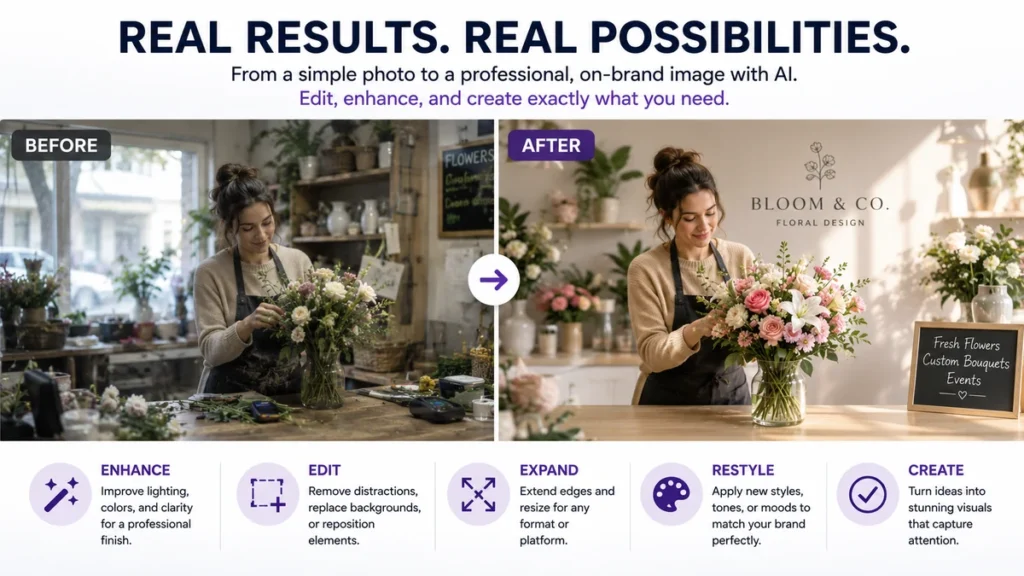
AI image tools can turn written descriptions into new visuals or help edit existing images. A small business might use them to explore product concepts, develop campaign ideas, create social-media graphics or prepare website imagery. The strongest results usually come from a clear visual brief and sensible human review—not from pressing a button and accepting the first output.
Videos
AI video tools can generate scenes from text, animate still images, create presenter or avatar videos and accelerate editing. This can help a business produce explainers, demonstrations and short promotional content without beginning with a full camera crew. Quality, realism and control vary, so the intended use matters when choosing a tool.
Content
AI content tools can help outline articles, draft emails, summarise research, generate campaign variations and improve existing copy. They work best when you provide the audience, objective, relevant facts and desired tone. Without that context, the result often sounds generic because the AI has been asked to guess what matters.
Automation and orchestration
AI automation connects repeatable tasks and information across tools. For example, an enquiry could be captured from a form, summarised, added to a customer system and routed to the correct person. Orchestration goes a step further by coordinating several tools, models or agents as parts of a larger workflow. Beginners should start with a small, low-risk process they already understand.
How Does Generative AI Work in Practice?
A useful beginner workflow has four steps:
- Describe the result you need. State the task and the outcome, not merely the name of a topic.
- Provide relevant context. Explain the audience, purpose, important facts, tone, format and restrictions.
- Review the generated result. Check facts, wording, omissions, suitability and anything that could create risk.
- Refine it. Tell the AI what to retain, change, remove or improve, then repeat until the result is genuinely useful.
Simple Prompt Example: Create three friendly Facebook post ideas promoting a Belfast web-design business to local small-business owners. Each idea should explain one practical benefit, avoid jargon and end with a clear next step.
This prompt works better than “write a Facebook post” because it identifies the business, audience, number of ideas, tone, focus and desired ending.

What Generative AI Does Well
Generative AI is particularly useful when speed and variation matter. It can help you:
- Turn a blank page into a first draft.
- Explore several directions quickly.
- Summarise or reorganise supplied information.
- Produce alternative headlines, layouts or concepts.
- Adapt material for different audiences and formats.
- Reduce time spent on repetitive creative preparation.
These advantages are most valuable when the person using the tool understands the desired outcome. AI can accelerate judgement; it does not automatically supply good judgement.
What Generative AI Does Not Do Reliably
Generative AI can produce convincing material that is incomplete, unsuitable or simply wrong. It does not reliably:
- Guarantee factual accuracy.
- Understand your business without being given context.
- Replace legal, financial, medical or other qualified professional advice.
- Make every output original, unbiased or commercially suitable.
- Remove the need to check privacy, copyright, licensing and provider terms.
That does not make the technology useless. It means the human user remains responsible for deciding whether the output is accurate, appropriate and safe to use.
How Could a Small Business Use It?
A small business does not need an ambitious “AI transformation” programme to benefit. It can begin with ordinary tasks such as:
- Drafting a clearer customer email.
- Brainstorming campaign angles.
- Creating concepts for social graphics.
- Planning a short demonstration video.
- Turning notes into a blog outline.
- Summarising a meeting or enquiry.
- Connecting a recurring administrative process.
The safest starting point is a task you already understand. You can then recognise whether the AI has produced something useful and catch mistakes before they reach a customer.
Which Type of AI Tool Should You Start With?
| If you want to… | Start with… |
|---|---|
| Create or edit visuals | AI Image Generation |
| Produce promotional or explainer videos | AI Video Generation |
| Draft, research or improve writing | AI Content Generation |
| Connect tasks and reduce repetitive work | AI Automation and Orchestration |
You do not need to master every category. Choose the one that addresses your most immediate and familiar need.
A Sensible First AI Exercise
Choose one low-risk task that you already know how to complete. Then:
- Describe the task and the desired result in plain English.
- Ask the AI for a first draft—not a “perfect final answer.”
- Check every important detail against what you know or a reliable source.
- Rewrite anything that is incorrect, unclear or unlike your voice.
- Compare the time, effort and quality with your normal process.
If the result saves time without lowering quality, you have found a sensible use. If it creates more correction work than value, improve the instructions or choose a different task.
Key Takeaways
- Generative AI creates new outputs from instructions.
- It can assist with images, videos, content and automation.
- Clear goals and relevant context improve the result.
- AI output can be wrong, so human review remains essential.
- Beginners should start with one familiar, low-risk task.
Frequently Asked Questions
Is generative AI the same as ChatGPT?
No. ChatGPT is one generative-AI product. Generative AI is the broader category that includes systems for producing text, images, video, audio, software and other outputs.
Do I need technical knowledge?
No. Many tools accept ordinary written instructions. Learning to provide clearer goals, context and constraints will improve the results, but you do not need to become a programmer.
Is generative AI free?
Some providers offer free access or limited plans. Advanced features, higher usage allowances and particular commercial capabilities frequently require a paid plan. Pricing and limits can change, so check the provider’s current terms.
Can I use AI-generated work commercially?
Sometimes, but the answer depends on the tool, plan, source material, jurisdiction and intended use. Check the provider’s current licensing and commercial-use terms, and obtain professional advice where the stakes justify it.
Will generative AI replace people?
It is more useful to view generative AI as a capability that can accelerate parts of a person’s work. Human judgement, experience, responsibility, relationships and quality control remain important.
Choose Your First AI Starting Point
Explore K44’s carefully selected tools for AI image generation, video creation, content production and automation—without wading through an overwhelming directory.